The frost settles on the kitchen window in West Chester, and you stare at a bag of all-purpose flour. The house is quiet, smelling faintly of yesterday’s coffee, and the idea of baking fresh bread feels like a heavy, impossible chore reserved for professionals with endless free time.
You have been told artisan baking demands a physical sacrifice. You imagine heavy mixers, floured countertops, and hours of repetitive folding that keep you tethered to the kitchen all weekend.
But sitting on your stovetop is a heavy, enameled piece of cookware that holds a quiet, five-minute secret. You do not need to babysit your dough to achieve a shatteringly crisp crust and an airy, tender center.
The viral preparation method moving rapidly through Pennsylvania homes requires zero technical skill. It simply relies on trapped moisture and a terrifyingly hot oven to do the heavy lifting while you sleep.
The Micro-Bakery Illusion
Think of your heavy pot as a localized weather system. When a wet, shaggy mass of dough hits a searing hot surface, it immediately releases water vapor.
Commercial bakeries rely on massive, expensive steam-injection ovens to keep the surface of the dough flexible, forcing the crust to blister and expand before it sets.
Your home oven is naturally vented, meaning it actively pumps moisture out. But when you drop your dough into a cast-iron vessel and clamp the heavy lid shut, you create a pressurized micro-climate where steam cannot escape, transforming a sloppy, unkneaded dough into an artisan masterpiece.
Consider Marcus Vance, a 38-year-old civil engineer from Doylestown. Between managing project sites and the morning school run, he had no time to hover over a mixing bowl. He started stirring his ingredients together for exactly four minutes, realizing that kneading is completely unnecessary when you give water and flour enough time to hydrate on their own. He let the pot do the baking, and the results rivaled the local corner bakery.
Adjusting the Crumb to Your Routine
This minimal-contact method bends entirely to your schedule, allowing you to segment the effort into tiny, manageable windows of time.
- The cheap Balsamic Glaze trick that makes weeknight chicken look expensive
- Your French Press makes bitter coffee because of this morning error
- The missing ingredient that forces any Sourdough Starter to double overnight
- Supermarkets hide this zero-waste storage secret for Avocados
- A 30-second trick stops eggs from sticking to any Stainless Steel Pan
- The pantry storage mistake ruining your Apple Cider Vinegar
- Chefs never grill a Ribeye Steak without this 2-ingredient crust
- Major fast-food chains are secretly changing how they fry French Fries
- A massive Mediterranean drought just triggered an Olive Oil shortage in PA stores
For the Weekday Purist: You want fresh bread to serve with Tuesday night’s soup. You mix right before bed, leaving the bowl on the counter. By 5 PM the next day, the dough is bubbling and ready for a blazing hot oven.
For the Chaos Manager: Sometimes the counter is too warm, or your schedule shifts abruptly. Pop the covered bowl directly into the refrigerator. It can hibernate there for up to three days, developing a cold-fermented, complex tang that mimics an expensive sourdough.
For the Flavor Chaser: The basic four-ingredient formula is a blank canvas. During your initial mixing phase, you can fold in roasted garlic, sharp cheddar chunks, or heavily toasted walnuts, letting those oils permeate the dough as it sits.
The Five-Minute Bench Protocol
This approach is not about perfectly measured techniques or anxious hovering. It is a sequence of mindful, deliberate actions that take up almost zero physical space.
When handling the shaggy mass, avoid burying your hands in raw flour. Instead, wet your hands first, creating an invisible glove that prevents the sticky dough from clinging to your fingers.
- Weigh 400 grams of bread flour, 8 grams of kosher salt, and 1 gram of instant yeast into a bowl.
- Pour in 300 grams of warm water, hovering around 90 degrees Fahrenheit.
- Stir with the thick handle of a wooden spoon until it forms a ragged ball, then stop immediately.
- Cover the bowl tightly with a plate and walk away for at least twelve hours.
The Tactical Toolkit requires your oven to be set at 450 degrees Fahrenheit. Your cooking vessel must preheat completely empty for a full thirty minutes to build an aggressive baseline heat.
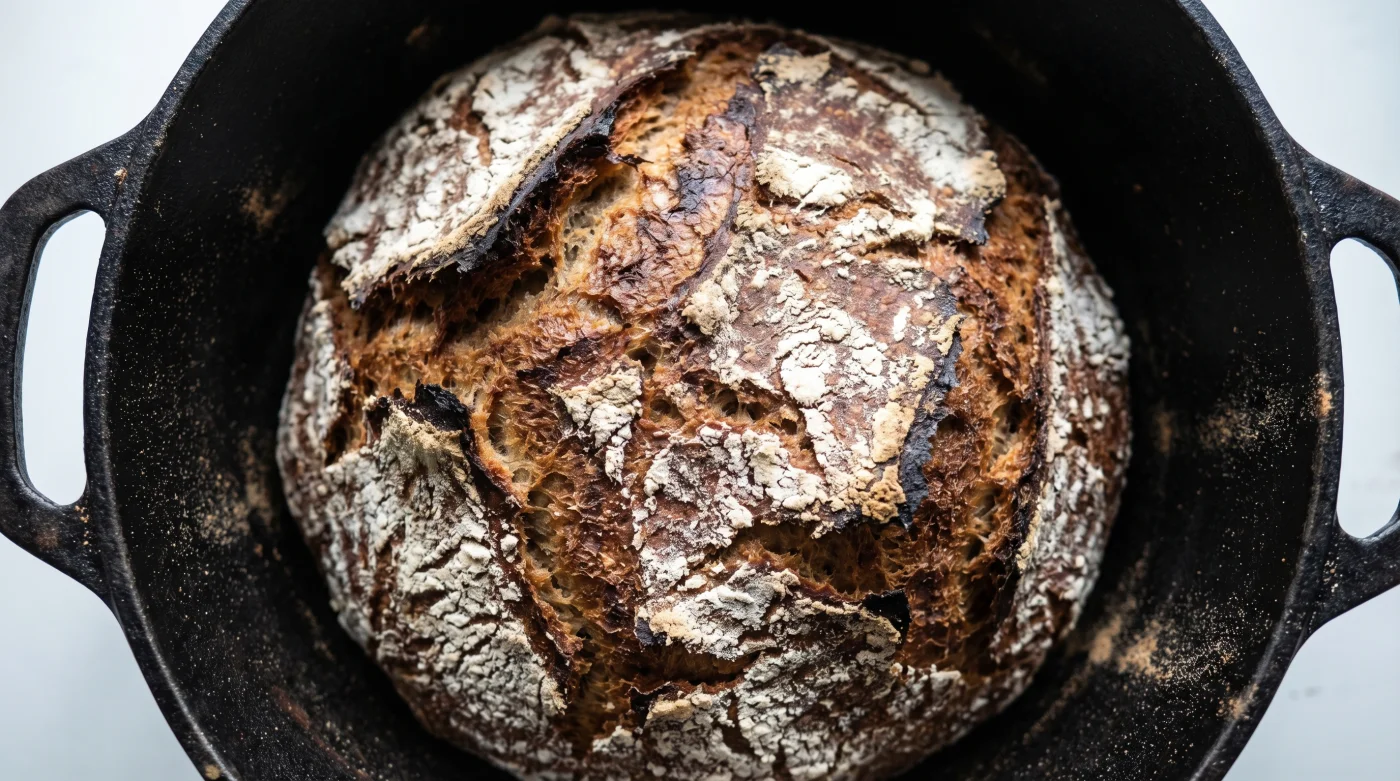
Once the dough is inside, bake covered for exactly thirty minutes to maximize the steam environment. Then, remove the lid and bake for another ten to fifteen minutes until the crust turns a deep, crackling mahogany brown.
The Anchor in a Rushed World
We operate in a state of constant, exhausting motion. The idea of baking from scratch often feels like a romantic luxury that belongs in a different century.
But the act of reclaiming this physical act shifts the energy of your kitchen. Slicing into a hot loaf that you barely had to touch grounds you in the tangible, sensory world, pulling you away from screens and schedules.
You realize that creating something exceptional does not always demand your suffering, your sweat, or your entire weekend.
Sometimes, it simply requires trusting the process, stepping back, and leaning on a few moments of quiet intention and a heavy iron lid.
The true secret to artisan baking at home isn’t the strength in your hands, but the steam trapped inside your pot.
| Key Point | Detail | Added Value for the Reader |
|---|---|---|
| Hydration | Using a wet dough (75% water ratio) | Eliminates the need for physical kneading entirely. |
| Trapped Steam | Baking inside a closed, heavy pot | Creates a flexible, blistering crust that mimics commercial ovens. |
| Extended Time | Letting the dough sit for 12+ hours | Develops complex flavors while you sleep or work. |
Frequently Asked Questions
Do I need to preheat the Dutch oven?
Yes, preheating the empty pot for thirty minutes at 450 degrees Fahrenheit is non-negotiable for a tall, airy loaf.Can I use all-purpose flour instead of bread flour?
You can, but bread flour contains higher protein, which gives the final loaf a chewier, more structural crumb.What if my dough is incredibly sticky?
It is supposed to be sticky. Do not add more flour; instead, wet your hands lightly with cold water before handling it.How do I prevent the bottom of the bread from burning?
Place a heavy baking sheet on the bottom rack of your oven, directly underneath the pot, to deflect the direct heat.Does the pot need to be enameled cast iron?
No, a raw cast iron pot works perfectly, provided it is well-seasoned and has a tight-fitting lid.