You stand at the stove on a quiet Tuesday morning, the harsh white light of the range hood cutting through the shadows of the kitchen. The coffee maker gurgles softly in the background as you hold a cold egg over a heavy metal skillet. You crack the delicate shell against the counter, expecting the satisfying, gentle sizzle of a perfect breakfast coming together in peace.
Instead of a clean glide across the surface, the white instantly seizes up, welding itself to the steel with a stubborn, aggressive hiss. You grab the spatula, scraping frantically at the edges, but the damage is done. Your morning meal has become a broken, scrambled mess of torn yolks and burnt protein stuck to the bottom of your favorite pan.
We are conditioned to blame the equipment when a durable skillet ruins a simple meal. You likely assume you need a heavy, greasy pour of butter or a slick, chemical-laden synthetic coating to achieve that flawless, sliding diner egg. The prevailing logic suggests that without an artificial barrier, sticking is an inevitable daily punishment.
The truth is entirely different, and it sits in your faucet. You do not need to drown your breakfast in excess fat to prevent a culinary disaster. The solution relies on a 30-second physical reaction that turns the metal itself into a frictionless surface, requiring only a fraction of the oil you are currently pouring into the skillet.
The Physics of Friction
Think of a cold piece of cookware as a microscopic, metallic sponge. To the naked eye, the heavy bottom looks incredibly smooth, polished, and unyielding. However, under high magnification, it is a treacherous, porous terrain of jagged peaks and deep valleys. When you drop raw, wet protein into that cold or mildly warm landscape, the metal expands as it continues to heat over the flame. As those pores grow and shift, they quite literally bite down on the egg white, locking the delicate food into place like a vice grip.
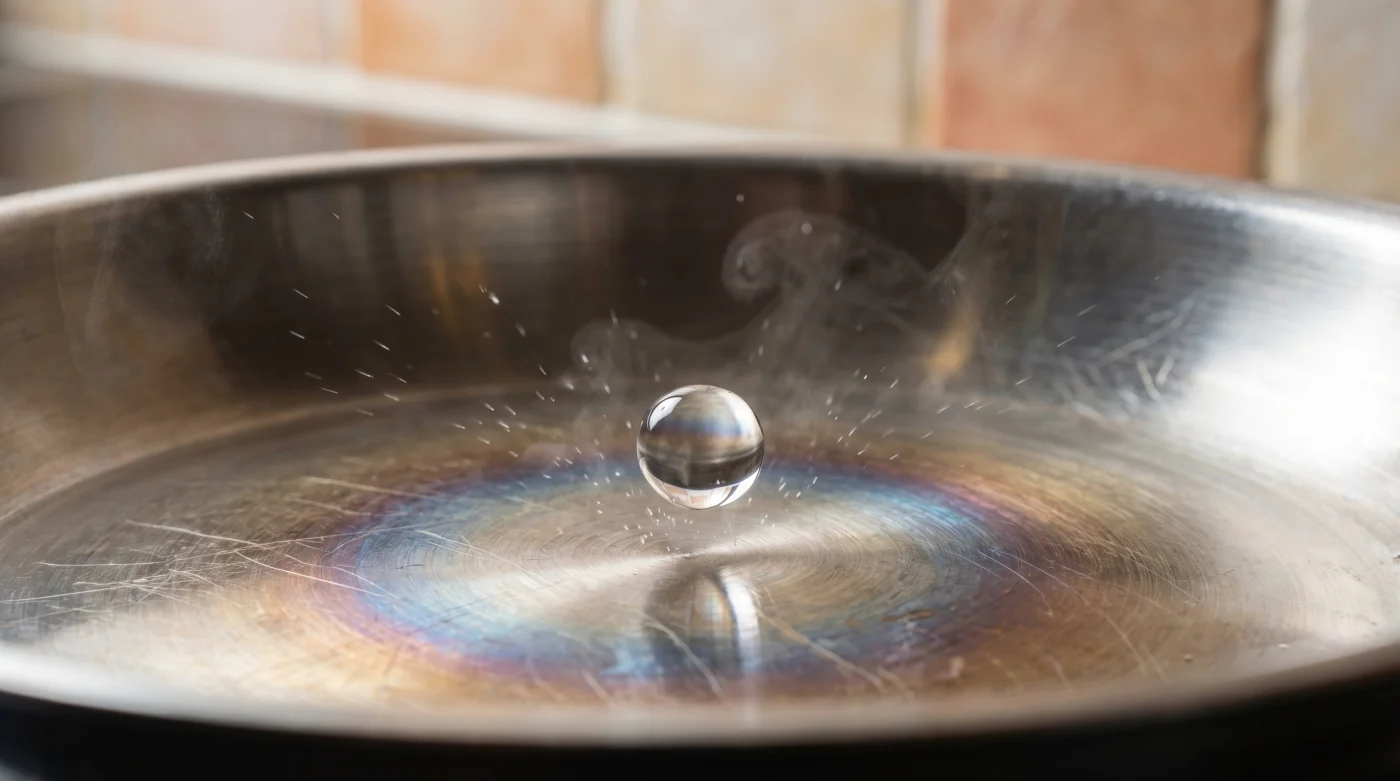
This is where a daily frustration becomes an advantage. If you understand how to close those microscopic pores before the food ever touches them, the pan transforms into an impenetrable, slick shield. The secret is the Leidenfrost effect, a natural phenomenon where intense heat creates a hovering cushion of vapor. You are not fighting the pan; you are using its sheer thermal power to float the egg just above the metal.
Marcus is a 46-year-old breakfast line cook running a bustling, narrow diner in South Philadelphia, moving with a calm, rhythmic economy of motion. He cooks hundreds of orders every single morning on beaten-up, heavy-bottomed pans without a single drop of chemical cooking spray. His secret is entirely auditory and visual. Before any fat hits the surface, he flicks a few droplets of tap water from his fingertips onto the hot steel. If the water simply spits and vanishes, the metal is too cold. But when those droplets suddenly bead up and skate across the skillet like tiny glass marbles, he knows the invisible vapor barrier is locked in place. Only then does the butter go down, foaming instantly to create a slick runway for the eggs.
Adjusting for Your Morning Routine
Not every breakfast requires the exact same thermal approach once the metal is primed. The way you treat the invisible barrier changes depending on how you prefer your yolks, requiring subtle adjustments to your heat control after the initial water test.
- The pantry storage mistake ruining your Apple Cider Vinegar
- Chefs never grill a Ribeye Steak without this 2-ingredient crust
- Major fast-food chains are secretly changing how they fry French Fries
- A massive Mediterranean drought just triggered an Olive Oil shortage in PA stores
- The 5-minute Dutch Oven bread secret sweeping Pennsylvania kitchens
- The cheap Balsamic Glaze trick that makes weeknight chicken look expensive
- Your French Press makes bitter coffee because of this morning error
- The missing ingredient that forces any Sourdough Starter to double overnight
- Supermarkets hide this zero-waste storage secret for Avocados
For the Sunny-Side Purist
You want delicate, lacey white edges without burning the bottom into a tough, rubbery disk. Once you achieve the water-skate stage, quickly wipe the beads away with a paper towel. Lower the burner to a medium-low setting and immediately add a small pat of butter. The residual heat stored in the thick bottom keeps the pores closed, while the cooler flame gently sets the egg white, ensuring it cooks evenly without turning to plastic.
For the Fast Scrambler
Scrambled eggs demand constant motion, and constant movement creates friction points. Once you hit the Leidenfrost temperature, you need a slightly heavier fat base to compensate for the spatula scraping the bottom. Swirl a teaspoon of olive oil or clarified butter to coat the sides where the liquid will be pushed. The trick here is to pull the pan entirely off the burner right before the eggs look finished; the heavy steel will carry them the rest of the way to soft, fluffy perfection without sticking.
For the Omelet Architect
Building an omelet on untreated metal feels like a high-wire act. You need the exterior to form a cohesive, slightly browned skin that will release easily when folded. After the water beads dance, add your butter and let it brown very slightly to boil off its water content. Pour the beaten eggs in, let the bottom set for ten seconds undisturbed, and then gently pull the edges inward. The vapor cushion will keep the bottom detached as the liquid fills the empty gaps.
The 30-Second Water Dance
Bringing this specific technique into your kitchen requires only patience and a steady hand. You are orchestrating a precise physical reaction, so let the heat build without rushing.
- Place your clean, completely dry skillet on a medium flame.
- Wait exactly two to three minutes. Resist the urge to add oil or butter prematurely.
- Wet your fingers under the sink and flick three or four drops of water into the center of the metal.
- Watch the reaction: if the liquid spits aggressively and vanishes instantly, wait 30 more seconds.
- If the droplets form cohesive, mercury-like beads that bounce and glide around the surface in a single cluster, you have reached the threshold.
- Wipe the remaining moisture out quickly with a dry towel, drop in your fat, and immediately add the cracked eggs.
This simple, daily sequence builds a practical, tactical toolkit for any protein you decide to cook in your kitchen.
- Target Temperature: Roughly 380° Fahrenheit, where the Leidenfrost threshold activates.
- Time Investment: A mere two minutes of dry pre-heating.
- Fat Ratio: Only a fraction of a tablespoon, used to flavor the egg rather than protect it from the metal.
Reclaiming the Morning Rhythm
Mastering the water drop test changes how you interact with your physical kitchen space. It shifts your focus from hoping for a lucky release to actively controlling your cooking environment. You stop fearing heavy, durable cookware and start trusting the reliable physics of heat.
A morning routine should be a quiet, calming start to the day, rather than reacting to a sticky mess. When you finally watch that egg slide effortlessly onto your plate, leaving behind a practically clean surface, you realize the kitchen is no longer a place of frustration. You have learned the quiet language of your tools, turning a mundane daily chore into a small, highly satisfying victory of precision.
“You do not need a chemical coating to make food release; you simply need to listen to the pan and respect the temperature.”
| Key Point | Detail | Added Value for the Reader |
|---|---|---|
| The Leidenfrost Effect | Vaporizes water to create a hovering cushion above the hot metal. | Prevents eggs from touching the microscopic pores of the steel. |
| Dry Pre-heating | Heating the pan completely empty for two to three minutes. | Allows the metal to fully expand before fat is ever introduced. |
| Minimal Fat Usage | Using a fraction of a tablespoon of butter or oil. | Saves money and reduces heavy breakfast calories without losing flavor. |
Frequently Asked Questions
Why does my water immediately boil away instead of beading up?
Your pan is simply too cold. The metal has not reached the threshold to vaporize the bottom of the water droplet instantly, so it just boils. Wipe it dry and wait another 30 seconds.Can I use olive oil instead of butter after the water test?
Yes, olive oil works perfectly. Just remember to add it immediately after wiping the water beads away so the oil does not smoke, as the pan is quite hot.Does this trick work on cast iron as well?
It does, though cast iron has a rougher natural texture. The Leidenfrost effect still applies and will significantly reduce sticking on well-seasoned iron.What if the egg still sticks a little bit on the delicate edges?
Your heat may have been slightly uneven, or your pan might have had residual burnt bits before starting. Ensure the skillet is completely clean before attempting the pre-heat.How do I clean the pan if I mess up the temperature and burn an egg?
Fill the hot pan with an inch of warm water and a drop of dish soap. Let it simmer for five minutes on the stove, and the stuck protein will lift off with a gentle scrape of a wooden spoon.